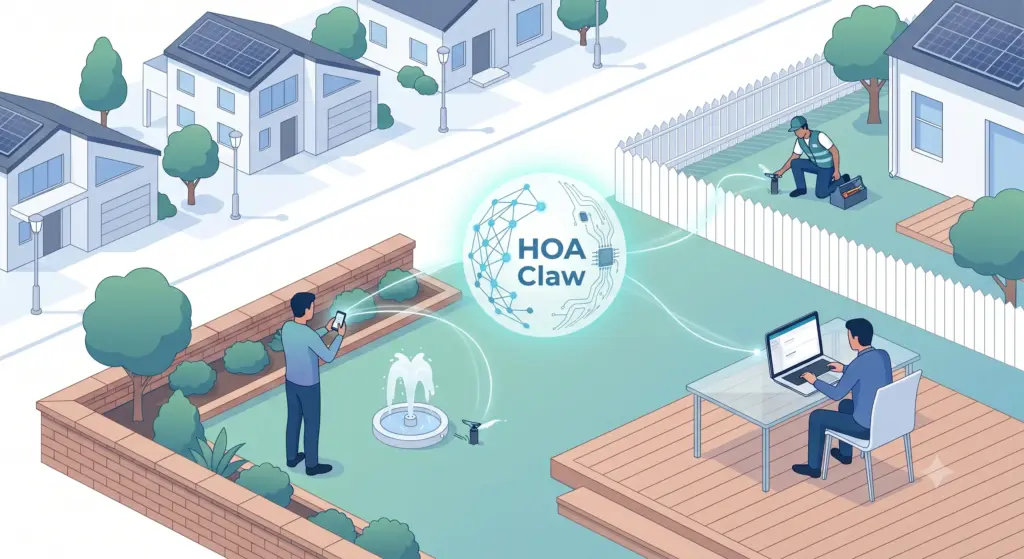
Every HOA board member and property manager knows this story. A resident notices a broken sprinkler at 7am. They text a neighbor, who says call the office, who says email the property manager, who forwards it to a vendor — maybe. Three days later nobody knows if it ever got fixed.
That’s the real problem with running a community: everyone’s working out of a different tool. Email, WhatsApp, phone calls, paper forms. Every hand-off is a chance for something to get lost.
HOA CLAW fixes that by putting an AI agent on the front line. Residents just message Telegram or email like they normally would, the agent turns that into a real ticket, and the system carries it through vendor assignment, updates, and invoice approval — without anyone learning a new tool.
What’s actually broken today
Talk to any property manager and you’ll hear the same complaints:
- Requests come in over five different channels with no single record of any of it
- Vendor coordination means calling someone, waiting, and following up when they forget
- Invoices sit in someone’s inbox until the right board member notices
- When something goes wrong, nobody can piece together who said what
- Residents have no idea if their request even got seen
Most HOA software gives you a shared ticket list and calls it done. That still leaves everything above untouched.
How it actually works
Say a resident notices that sprinkler spraying onto the sidewalk. Here’s what happens:
They message the community’s Telegram or email, photo attached. The AI checks they’re a registered homeowner, figures out what’s broken and where, and files a ticket. That ticket shows up in the property manager’s queue already sorted, photo and all.
The property manager acknowledges it with one click — resident gets notified. They assign a landscaping vendor, who gets pinged on whatever channel they use. Vendor accepts, starts the work. They finish the job, mark it done, and the resident’s notified automatically.
Then the invoice moves through: vendor uploads it, property manager reviews it, board gives final sign-off. The resident sees every one of these steps — acknowledged, assigned, in progress, done — right in the same chat thread they started.
What makes it work
The AI only takes actions it’s allowed to take. It’s not just generating text and hoping for the best — filing a ticket, assigning a vendor, or approving an invoice all go through set steps with required information. Nothing gets logged just because it sounded right.
Messages stay on one thread no matter the channel. Start on Telegram, reply by email, it’s all the same conversation. Reply to an update in your inbox and it lands back on the same ticket instead of starting something new.
Four views, one system. Admins see everything. Board members see tickets and approve invoices. Property managers handle the day-to-day — assigning, following up, closing things out. Vendors just see their own assigned work.
Invoices need two signoffs. The vendor submits it against a completed job, the property manager reviews it, and the board approves it. The homeowner gets told once it’s actually approved.
Notifications follow the person, not the app. Get pinged on Telegram, email, or both — whatever you actually check. Nobody needs to log into anything to find out something happened.
Every ticket keeps a full history. Status changes, comments, approvals — all recorded, so if something needs explaining later, the record’s already there.
Why messaging instead of a portal
If reporting a leak means installing an app and remembering a password, most people just won’t bother twice. That’s why HOA CLAW leans on channels people already use — Telegram for a chat-first experience with photos, email for people who’d rather stay in their inbox (which, frankly, is most vendors and property managers anyway).
What it means day to day
Homeowners — message in a photo, get updates in the same thread, reply anytime and it lands on the right ticket. No portal, no password.
Property managers — one queue, already sorted. Acknowledge with a click, assign a vendor, track progress, pass invoices to the board — no manually copying anyone in on anything.
Vendors — see only your jobs. Accept or reject in one tap, mark progress, upload your invoice, get pinged wherever you prefer.
Board members — see what’s happening without micromanaging it. Approve invoices the property manager already vetted. Pull up the full history on anything.
The bottom line
Running a community works when everyone can see the same story — what got reported, who’s on it, what’s next. HOA CLAW just tries to make that the default, instead of something you have to chase down.
It works with the systems already in place
The hesitation around a tool like this is almost always the same: a community already runs software for its tickets and vendors and invoices, and adopting something new sounds like starting over — replacing the system, moving the data, retraining everyone. But that software is just a SaaS application — a web app and a database that already knows how to do the day-to-day. The only thing it’s missing is a way for an AI to reach it.
So nothing was replaced. The existing HOA SaaS was wrapped by the Enterprise CLAW SDK to expose the operations it already had — “file a ticket,” “assign a vendor,” “approve an invoice” — as tools the AI can use, over MCP. The original system stayed the source of truth; the wrapper just gave a language model a door into it. A resident’s Telegram message became a real, validated action in the same system the office already ran — not a second place to keep track of things.
The AI is what makes it more than a records system: it reads the message, works out what’s being asked, and files the ticket, instead of waiting for a person to type it in. And since it works over Telegram and email, there’s no new app to learn.